Rendering a Trustworthy Global Tracking Map from Messy Route Data
How I turned sparse, inconsistent tracking coordinates into a believable global shipment map using geospatial normalization, antimeridian correction, and conservative current-position logic.
Context
Maps create instant emotional trust, which is exactly why bad tracking maps are so dangerous.
Users do not inspect a route line the way engineers inspect payloads. They glance once and decide whether the system seems believable. In this tracking product, carrier data arrived with all the normal real-world issues: incomplete location history, future legs mixed with past ones, inconsistent GeoJSON shapes, and occasional coordinate spikes that could make a shipment appear to jump across oceans.
A straight-line map was easy. A map that stayed honest under bad data was the real work.
Problem
Several failure modes kept turning up:
- Future-only route points looked like a current position.
- Antimeridian crossings made the route draw across the entire map.
- Coordinate spikes created impossible path jumps.
- Some payloads contained points, some contained lines, and some contained both.
- Long routes produced too much geometry for a clean, responsive UI.
These were not cosmetic bugs. They changed what users believed about the shipment.
Constraints
I had to solve this without inventing certainty.
- Sparse data had to stay sparse if that was the truth.
- The map needed to work for both operator review and customer-facing tracking.
- Rendering had to stay fast enough for live browser use.
- The output had to survive global routes, not just tidy domestic examples.
- Fixes had to align with the normalized API model, not become frontend-only hacks.
That meant the job was half geospatial processing and half product judgment.
What I Changed
I approached the problem by making the route model explicit instead of letting the map library guess.
First, I normalized route geometry into a predictable internal shape. Upstream data could arrive as point collections, line strings, mixed structures, or partial fragments. I converted those inputs into one consistent representation before the frontend ever tried to render them.
Second, I made current-position logic conservative. If all known points were future-dated, the system returned null for current position instead of pretending the earliest future point was current. That seems like a small choice, but it prevented a huge amount of false confidence.
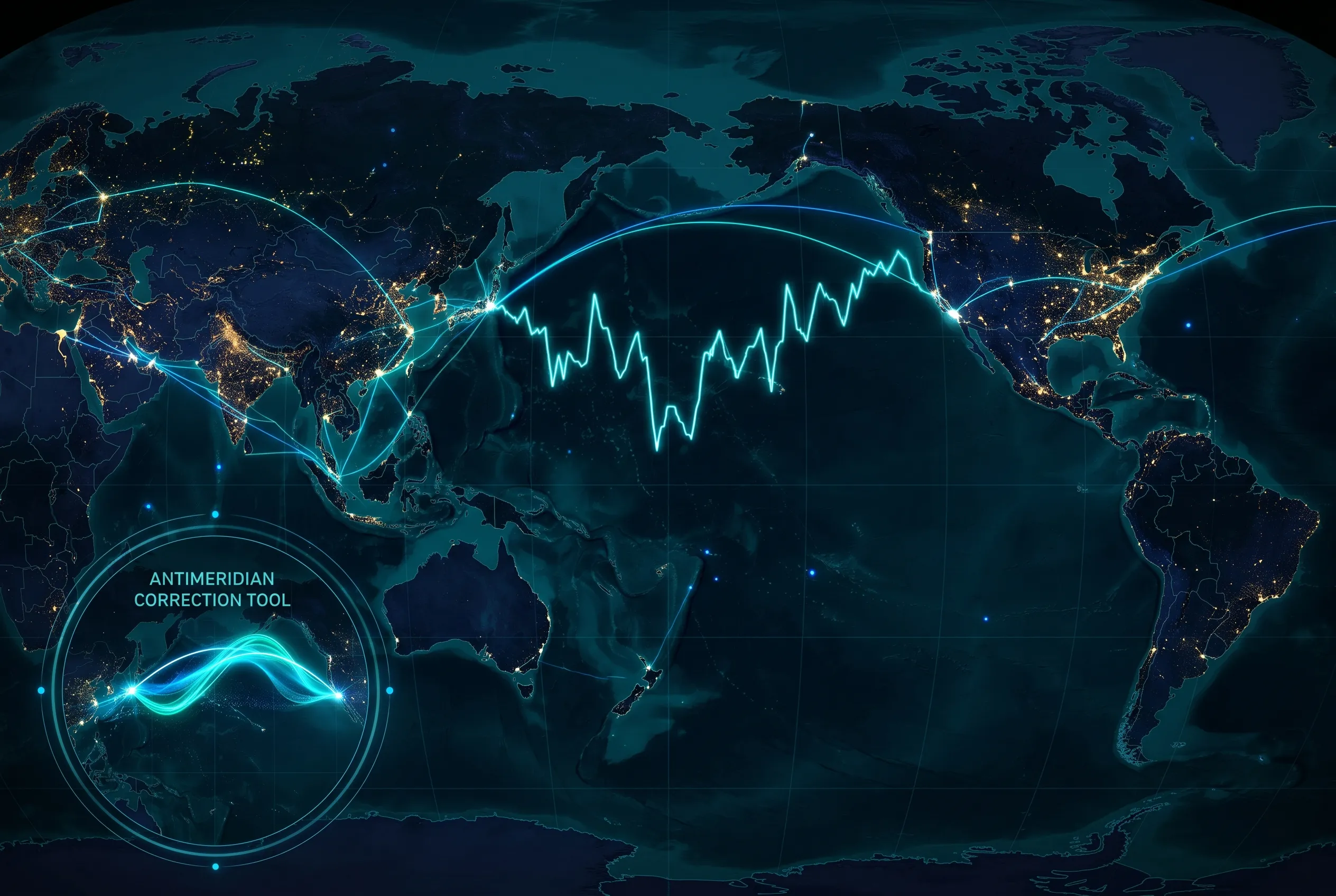
Third, I corrected antimeridian behavior deliberately. Global freight routes do not respect convenient map assumptions. I normalized longitudes and split segments where needed so trans-Pacific or trans-global routes did not wrap the wrong way and draw nonsense across the viewport.
Fourth, I pruned impossible spikes and segmented unrealistic jumps. Some upstream paths contained coordinate errors or timing gaps severe enough to create visually absurd motion. I used speed- and distance-aware logic to break or discard obviously bad segments rather than rendering them as if they were real travel.
Fifth, I separated past and future route intent. That gave the UI a cleaner model for what had happened versus what was projected or upcoming. It also made the map easier to style in a way that communicated uncertainty without long explanations.
Finally, I added geometry sampling discipline. Long breadcrumb histories can make a map technically complete but practically sluggish. I capped and sampled point collections so the frontend could stay responsive while still preserving the shape that mattered to users.
Validation
Validation for this work had to be visual as well as technical.
I tested known edge cases:
- routes that crossed the antimeridian
- payloads with only future positions
- sparse journeys with large timing gaps
- noisy coordinate histories with obvious spikes
- long-haul routes that produced heavy breadcrumb sets
I also reviewed the rendered output against user expectations, not just code correctness. The question was always, “Would an operator or customer believe this for the right reasons?” If the answer was no, the geometry rules needed more work.
Outcome
The result was a tracking map that felt much more trustworthy.
- Current position stopped overstating certainty.
- Global routes rendered as believable journeys instead of broken arcs.
- Visual spikes and impossible jumps dropped out of the customer experience.
- The route view stayed performant enough for real browser usage.
- The API and UI shared the same truth model instead of fighting each other.
This page matters to me because it shows a type of engineering work that gets undervalued: making data quality visible in the right way. Good product teams know that visualization is not just presentation. It is interpretation.
Lessons
Map accuracy is not just about coordinates. It is about honesty.
Users forgive incomplete data faster than they forgive misleading data. A blank current-position field is better than fake precision. A broken route segment is better than an impossible one. When the system is unsure, the UI should reflect that instead of dressing it up.
That is the difference between a tracking map that looks flashy and one that people actually trust.
If you have route, telemetry, or tracking data that looks fine in logs but falls apart in the UI, I would love to help untangle it. Let’s talk.